Ohio State's New ASL Major: What It Means for Central Ohio's Deaf Community
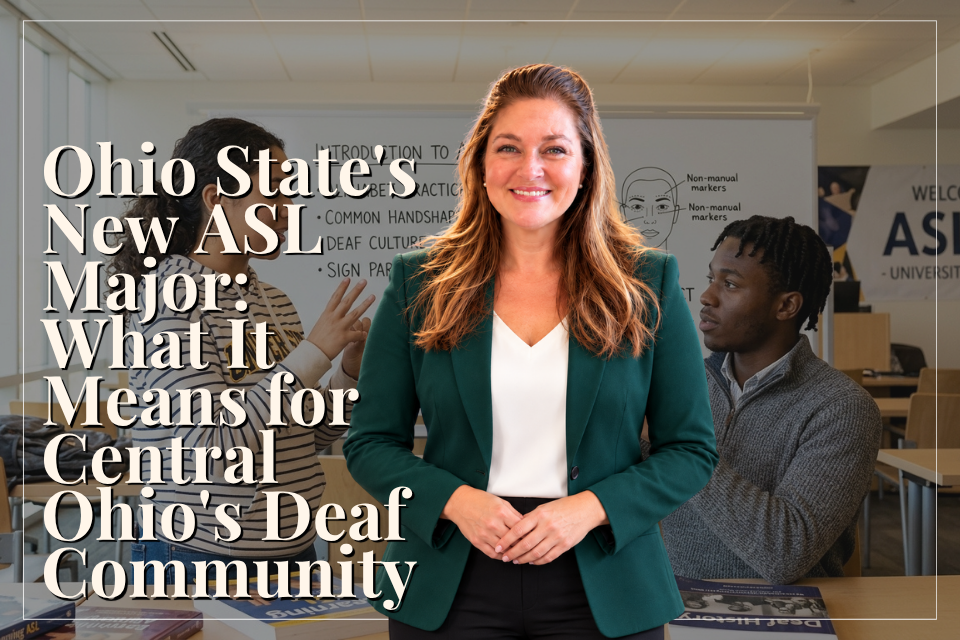
What the new program covers, the early enrollment numbers, and the Central Ohio connection.
Ohio State launched an undergraduate American Sign Language major in 2026, with Deaf history and culture taught alongside the language. Here is what the program covers, the numbers behind it, and why it matters in Central Ohio.
Ohio State has added a new undergraduate major that reflects growing interest in American Sign Language and in the Deaf community that uses it. The program is also a reminder that Central Ohio is home to long-standing Deaf institutions and community networks. Here is what the university's own reporting says.
What Is Ohio State's New ASL Major?
According to Ohio State News, published October 14, 2026, the university launched an undergraduate major earlier in 2026 called ASL: Applied Communications and Community Studies. It covers language skills, intercultural competence, and Deaf cultures and histories. The article gives no approval details.
Deaf history is taught alongside the language, because understanding ASL means understanding the people who use it. Students can also complete service-learning with Deaf communities outside the university.
Who Helped Build the Program?
Kristin Wickham-Saxon, an assistant professional practice professor in the College of Arts and Sciences, helped develop the major. She has signed since childhood and is not a member of the Deaf community, and she worked with the ASL program to include Deaf perspectives. The article says both Deaf and hearing instructors contributed.
How Many Students Are Involved?
The numbers show strong interest and an early-stage program. Three students are officially enrolled in the major, with more expected. 150 students are enrolled in the ASL Studies minor, and the introductory course, ASL 1101, has long had a waitlist. Wickham-Saxon said about 180 Ohio high schools offer ASL.
Those figures are small for the major itself, which is normal for a program in its first year. The waitlist and minor enrollment point to demand that may grow.
Why Does the Program Matter Beyond the Classroom?
Wickham-Saxon said roughly 70% of U.S. families with deaf children do not sign. She noted that children without a solid language by about age 5 can face lasting linguistic and cognitive delays, and that families who do not know the language cannot serve as language models.
The program is also meant to build skills that transfer to any career, not only work directly with Deaf communities. Wickham-Saxon described it as serving the land-grant mission, with aims that include connecting students with local Deaf organizations and improving accessibility.
What Does the Program Say About Demand for ASL?
Several signs point to growing interest. The introductory course has long had a waitlist, the minor has 150 students, and about 180 Ohio high schools offer ASL, according to Wickham-Saxon. Taken together, that suggests students are arriving at college with some exposure and wanting to go further. A major gives them a structured path, and it gives employers and community organizations a clearer signal about what graduates have studied.
The article stresses that the skills are not limited to one career path. Language competence, intercultural understanding and accessibility awareness are useful in many workplaces, which is part of why a program like this can appeal to students with a wide range of goals.
What Is the Connection to Central Ohio?
The article says Central Ohio has the state's largest Deaf population, and the Ohio School for the Deaf is in Columbus. That long-standing presence means the region has community organizations, schools and professional networks connected to Deaf culture. For a new program, having those partners nearby is a real advantage.
Why Might This Matter to Newcomers?
If you are relocating to Central Ohio, community institutions are part of what shapes daily life. Universities, schools and nonprofit organizations bring programs, events and volunteer opportunities that make a region feel like home. Getting to know the ones that matter to you, whether that is a university program, a school or a community group, is a useful part of settling in.
If anyone in your household uses ASL or is part of the Deaf community, ask local organizations and the institutions mentioned here about resources and events. As with any move, the people and organizations in an area often matter as much as the address.
What Should You Do If You Are Interested in ASL?
A few next steps:
Explore classes. Ohio State's ASL offerings, including the minor and introductory course, are described on the university's site, and there may be a waitlist for introductory courses.
Look for community programs. Local organizations and adult education programs may offer classes outside the university, so ask what is available near you.
Learn about Deaf culture. Understanding the history and community alongside the language is part of the approach the program takes.
Frequently Asked Questions
What is Ohio State's new ASL major? It is an undergraduate major called ASL: Applied Communications and Community Studies, launched earlier in 2026. It covers language skills, intercultural competence, and Deaf cultures and histories.
How many students are in the program? Ohio State News reports three students officially enrolled in the major, 150 in the ASL Studies minor, and a long-standing waitlist for the introductory course ASL 1101.
Who helped develop the major? Assistant professional practice professor Kristin Wickham-Saxon helped develop it, working with the ASL program to include Deaf perspectives. Both Deaf and hearing instructors contributed.
Does the major include community work? Yes. Students can complete service-learning with Deaf communities outside the university.
What is the Deaf community presence in Central Ohio? The article says Central Ohio has the state's largest Deaf population and that the Ohio School for the Deaf is in Columbus.
If you are relocating to Central Ohio and want to understand the community institutions around different neighborhoods, I would be glad to share what I know and help you narrow your search. No pressure, just a local perspective.
This content is provided for informational purposes only and does not constitute legal or financial advice. All real estate services are provided in compliance with Fair Housing laws, RESPA, TCPA, the REALTOR® Code of Ethics, and Ohio Real Estate Commission advertising regulations. Equal Housing Opportunity. Chrisi Hagan, Collins Lassiter Group, Red 1 Realty.